
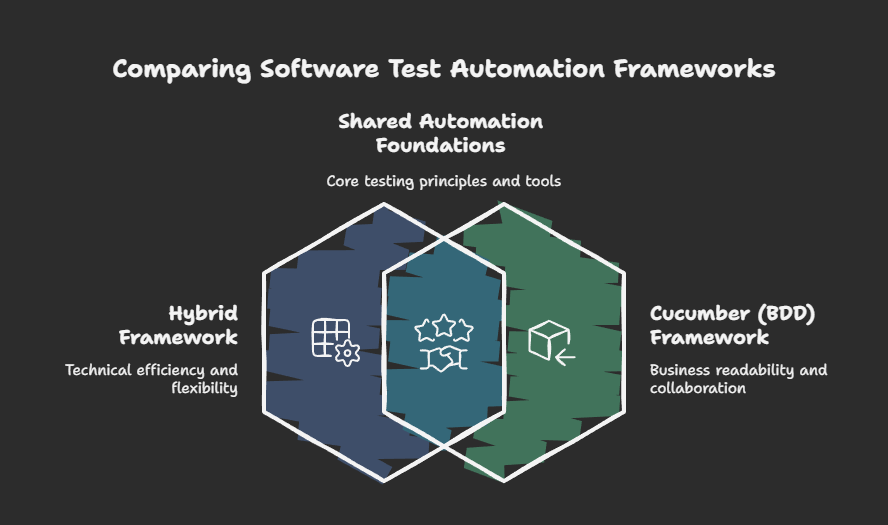
Choosing the right test automation framework is one of the most consequential decisions a QA team makes. Get it wrong and you're locked into a structure that fights you at every turn. Get it right and automation becomes a genuine asset rather than a maintenance burden.
Two frameworks dominate enterprise test automation discussions: Hybrid frameworks and Cucumber (BDD). Both are mature, battle-tested, and capable of covering complex testing scenarios. But they solve different problems, suit different team structures, and carry very different maintenance costs.
What Is a Hybrid Framework?
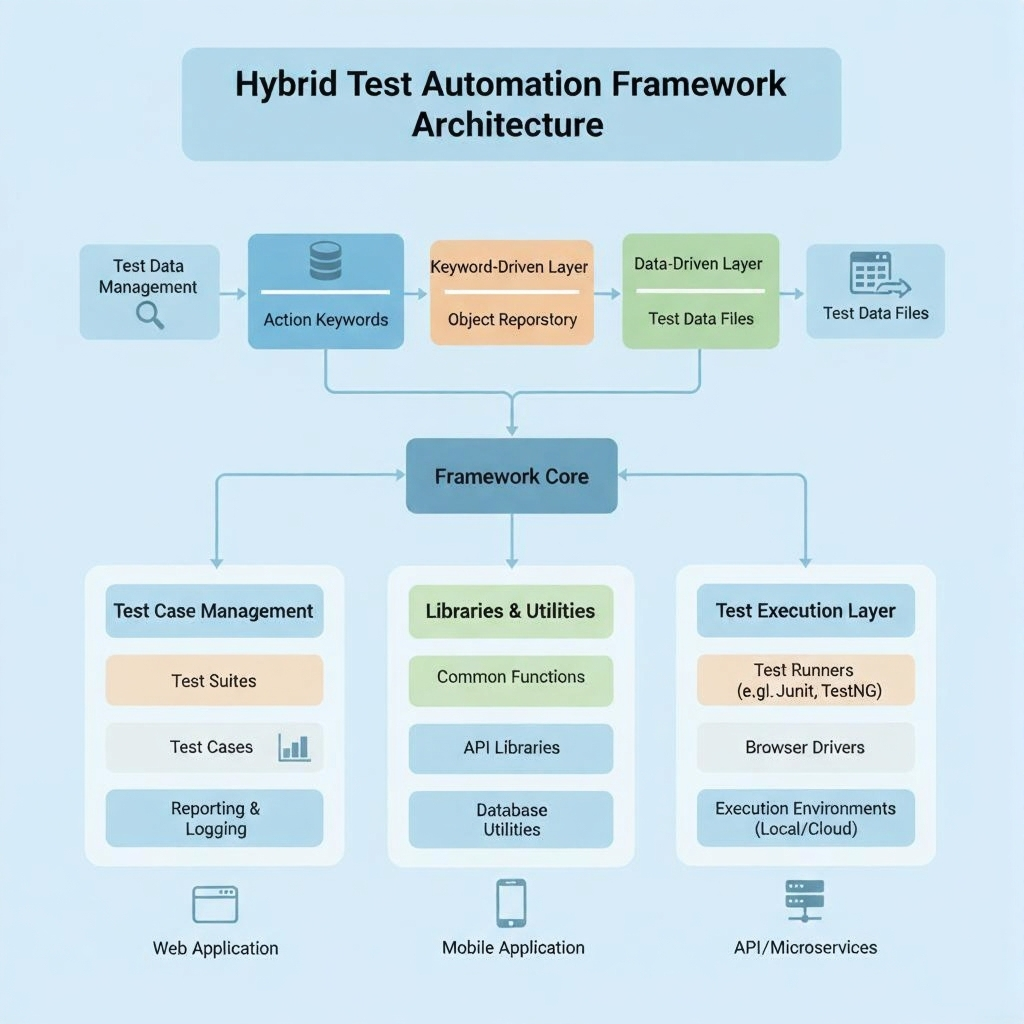
A Hybrid framework combines elements from multiple automation approaches â typically data-driven and keyword-driven â into a unified structure. The goal is flexibility: different test types can use the approach best suited to them within the same codebase.
Key characteristics:
- Combines data-driven and keyword-driven approaches
- Test logic and test data are separated
- Requires strong programming knowledge to build and maintain
- Highly customizable to project-specific needs
- Better suited for technical QA teams
What Is the Cucumber / BDD Framework?
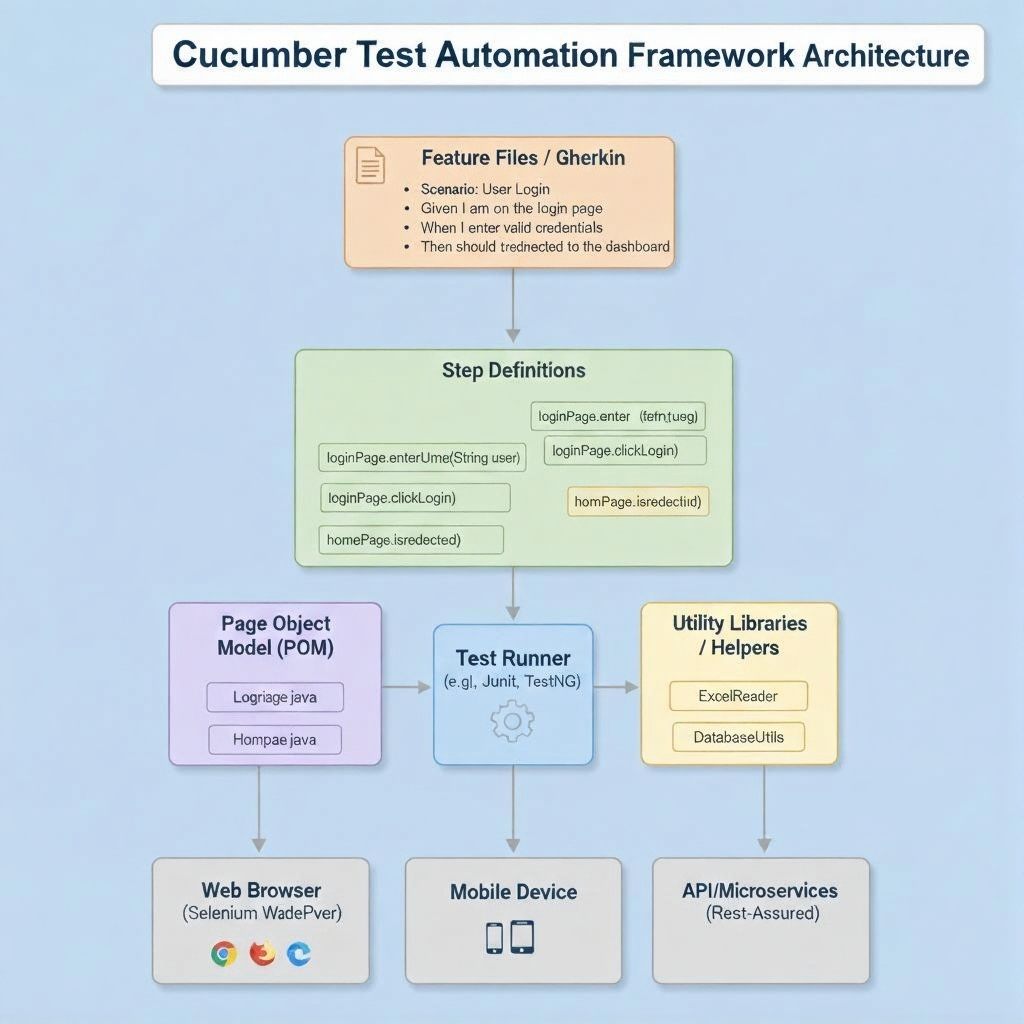
Cucumber implements Behavior-Driven Development (BDD) â a methodology where tests are written in plain English using the Gherkin language (Given/When/Then). The idea is that business stakeholders, developers, and QA can collaborate on test specifications in a shared language.
Key characteristics:
- Tests written in Gherkin (plain English)
- Bridges the gap between technical and non-technical stakeholders
- Living documentation that stays in sync with code
- Requires discipline to keep step definitions clean
- Works best when business stakeholders actively participate
Side-by-Side Comparison
| Dimension | Hybrid Framework | Cucumber / BDD |
|---|---|---|
| Primary audience | Technical QA engineers | Cross-functional teams |
| Test authoring language | Programming language (Java, Python, etc.) | Gherkin (plain English) |
| Learning curve | High â requires coding expertise | Low for writing specs, medium for step definitions |
| Maintainability | Good with proper architecture | Can degrade with poorly managed step definitions |
| Reusability | Excellent â keyword libraries are reusable | Good â step definitions can be shared |
| Stakeholder collaboration | Limited | High â designed for it |
| Reporting | Requires additional tooling | Built-in HTML/JSON reports |
| CI/CD integration | Straightforward | Straightforward |
| Best for | Complex technical testing | Acceptance testing, regulated industries |
When to Choose Hybrid
Choose a Hybrid framework when:
- Your team consists primarily of technical QA engineers comfortable with code
- You need maximum flexibility to handle complex test scenarios
- Business stakeholders won't actively participate in test authoring
- You're testing complex backend systems, APIs, or performance scenarios
- You need fine-grained control over test execution and reporting
When to Choose Cucumber
Choose Cucumber when:
- You're working in an environment where business stakeholders actively engage with test specifications
- You're in a regulated industry (healthcare, finance) where living documentation is valuable for compliance
- Your team includes non-technical members who need to understand what tests cover
- You're building acceptance tests that map directly to business requirements
- You want tests to serve as executable specification documents
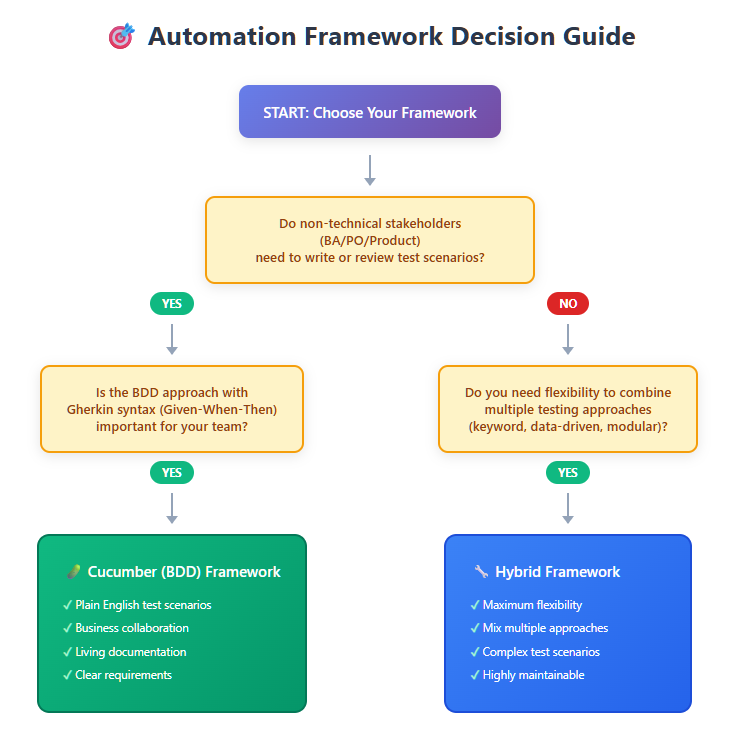
Framework Selection Guide
The Verdict
There is no universally superior framework. The right choice depends on your team's composition, your project's complexity, and how closely your testing process needs to align with business stakeholders.
In practice, many mature QA organizations end up with elements of both: Cucumber for acceptance and integration testing that bridges business and technical teams, and Hybrid for lower-level technical tests where the BDD structure adds overhead without proportional benefit.
The worst outcome is choosing a framework based on what's trending and then fighting against its constraints for years. Start with an honest assessment of your team and your testing goals â the right framework will follow naturally from that.